

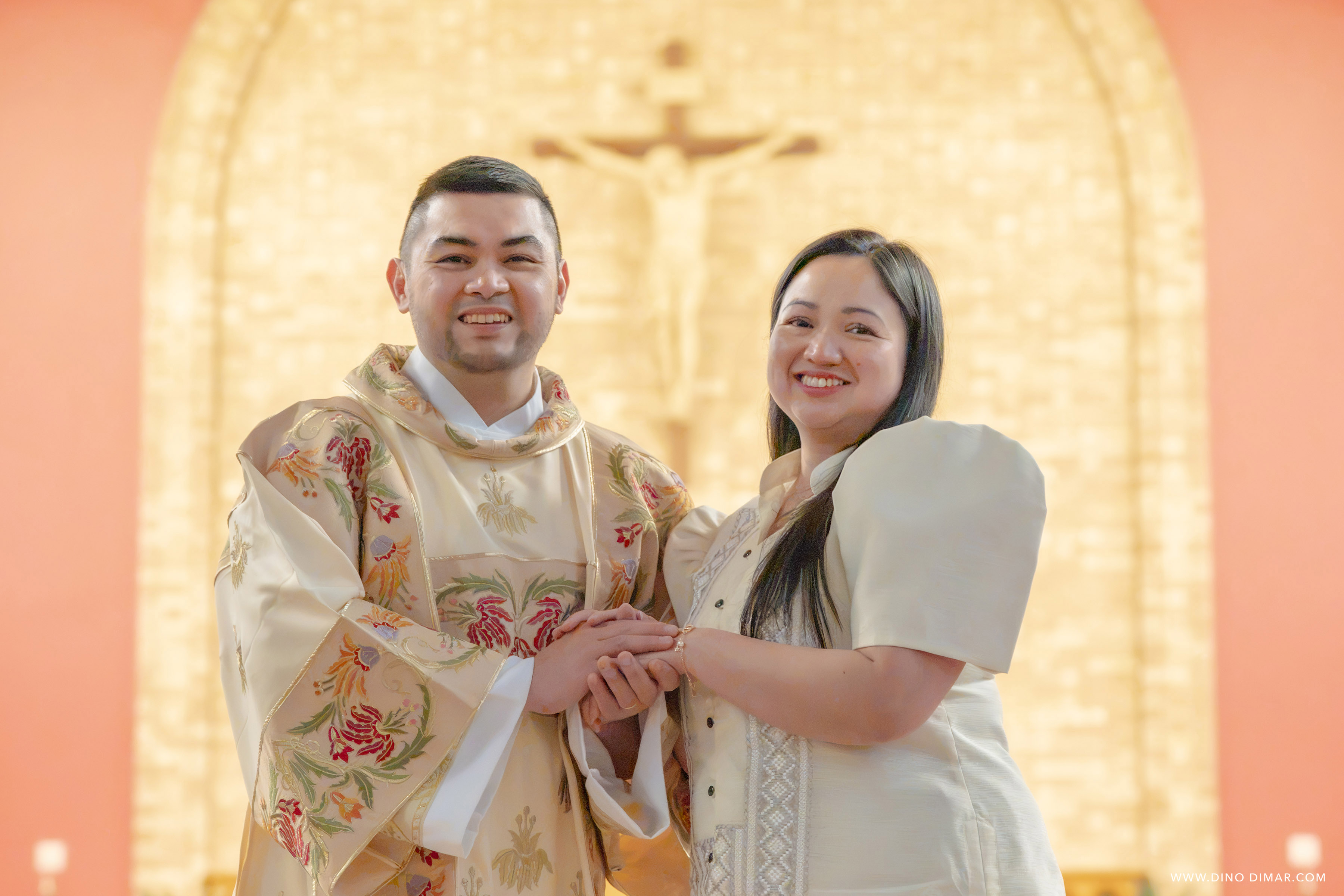
 The role of a permanent deacon is to serve and to walk alongside all people, according to Deacon Don Gomez, who was ordained to the diaconate in Canberra recently.
Deacon Gomez, one of Australia’s youngest permanent deacons at 38, said the diaconal ministry exists to serve the Church in a variety of ways and especially to assist the local bishop in areas of great pastoral need.
“My hope is to simply serve in whatever capacity I can,” he said.
“Accompaniment is also very important; to be there, to listen and to walk alongside people.”
Born and raised in the Philippines, Deacon Gomez didn’t even consider the diaconate prior to migrating to Darwin in 2015 with his wife and eldest daughter.
“In the Philippines, I think they're still exploring it, so the idea of becoming a permanent deacon was foreign to me when we moved to Australia,” he said.
“One of my parish priests in Darwin first suggested the idea of the diaconate to me. I maintained that curiosity… and in March 2019 after we had moved to Canberra I started inquiring with the Archbishop about it.”
Permanent deacons are often married, and differ from ‘transitional’ deacons, who are ordained as deacons as part of their path to priesthood.
As with preparation for the priesthood, Deacon Gomez received several years of formation for the diaconate, giving him time to examine his motivations, while his wife and two daughters also discerned what the change would mean for the family.
“To have the support of your wife is very important,” he said.
“It really should not only be the desire of the husband to become a deacon, but it should also be the desire of the wife and the family to serve God in this capacity, because it means we will be giving up a big chunk of our family time to ministry as we serve our bigger family, the Church.
“So far, I would say it isn't easy, but it's workable.”
After ordination, permanent deacons are often assigned a particular ministry, such as a school or hospital chaplaincy. But Deacon Gomez’s first assignment will be to continue his work for the Australian Catholic Migrant and Refugee Office and the national Clergy, Life and Ministry networks.
As a husband and father, Deacon Gomez said his priority will remain the ‘domestic church’, his family.
“We want to arrive at an understanding and maturity as a family where this won't be a separate ministry,” he said. “It's a ministry deeply ingrained in whatever we do as a family.
“And hopefully whatever good comes out of that domestic church will be reflected into the wider Church.”
Deacons have been a part of the Church since its earliest days (cf. Acts 6:1-6), but the permanent diaconate was not widely exercised until it was reinstituted in 1964 at the Second Vatican Council.
The first permanent deacon in Australia was ordained in 1972, and numbers have steadily grown since. The most recent statistics show that there were 204 permanent deacons in Australia in 2023, with most based in larger archdioceses.
The Norms for the Formation of Permanent Deacons outline the process of becoming a deacon in Australia. The norms stipulate that candidates for the permanent diaconate must be “a Catholic man of sound moral character and mature faith with a vocation to service” who is “actively supported by his wife and family if married”, among other requirements.
The Australian Catholic Deacons Association (ACDA) is the national support network for deacons, hosting national gatherings of formators, a biennial deacons conference, regular webinars and a quarterly newsletter.
President of the ACDA Deacon Tony Hoban said the diaconate offers the Church the fullness of ordained ministry.
“Some would say the Church is incomplete in any diocese without the threefold ministry of bishop, priest and deacon,” he said.
“Deacons serve their bishops wherever there is a need. This is grounded in parish liturgical and pastoral ministry, but also expressed in many other areas such as emergency services, hospital and prison chaplaincy, in administrative roles in parishes, dioceses and other Church entities, and also in secular workplaces where many deacons work.
“The richness of potential ministries performed by deacons is a great gift to the Church in Australia.”
Image: Photo by Dino Dimar of The White Canvas Studios
Words: Matthew Biddle